

A Colossal Tribute to Native American Heritage
Origins and Inspiration
The seeds of the Crazy Horse Monument were sown in the mid-20th century, when Chief Henry Standing Bear, a respected elder of the Oglala Lakota, sought a way to honor Native American heroes and affirm the enduring presence of Indigenous peoples on their ancestral lands. Chief Standing Bear reached out to Korczak Ziolkowski, a Polish-American sculptor who had assisted at Mount Rushmore, inviting him to create a monument to Crazy Horse. Ziolkowski accepted, inspired by the message and challenge, and work began in 1948.
Crazy Horse himself was a revered war leader who fiercely resisted U.S. encroachment on Lakota lands in the 19th century. He was instrumental in the defeat of Custer at the Battle of the Little Bighorn in 1876 and remains a symbol of indigenous strength, dignity, and resistance.
Design and Dimensions
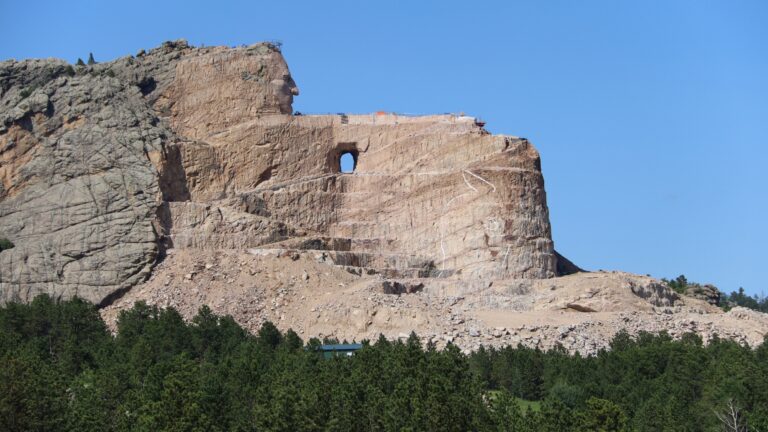
The scale of the Crazy Horse Monument is staggering. When complete, it will depict Crazy Horse astride a horse, pointing into the distance. The finished sculpture is planned to measure 641 feet long and 563 feet high—a size that dwarfs even the nearby Mount Rushmore, whose presidents’ heads could fit inside Crazy Horse’s head alone.
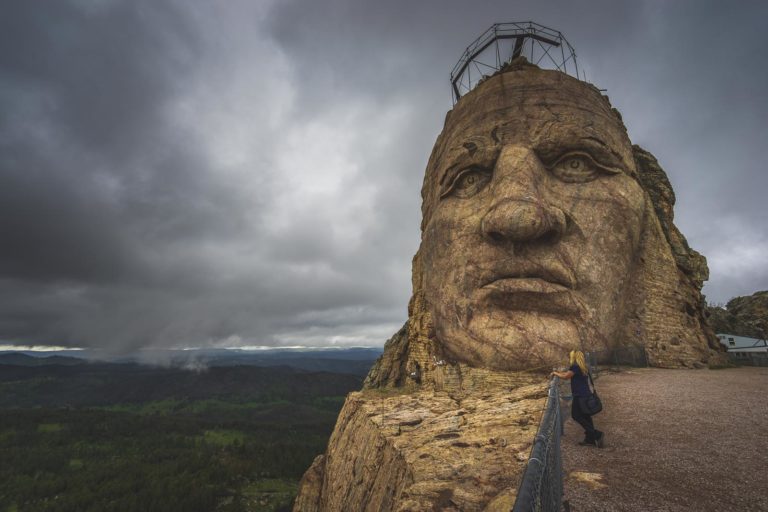
The face of Crazy Horse, revealed in 1998, is 87 feet tall. The pointing arm will measure more than 263 feet, while the horse’s head is designed to reach 219 feet high. The monument is being carved directly into Thunderhead Mountain, transforming the once-remote granite peak into a colossal tableau of Native American valor.
The Construction Process
Unlike Mount Rushmore, which was funded by federal money, the Crazy Horse Monument is built entirely with private funds, donations, and admissions. The project has refused government funding, adhering to Ziolkowski’s philosophy of independence and his desire to keep the project in line with the original vision of honoring Native Americans.
Carving a mountain is a herculean task. Work proceeds slowly, dictated by weather, funding, and technical challenges. The tools of the trade include dynamite, drills, and heavy equipment, wielded by a dedicated team of sculptors and workers. After Korczak Ziolkowski’s death in 1982, his wife Ruth and their children took over the project, sustaining the work with a sense of family and communal legacy.
Symbolism and Significance
The choice of Crazy Horse as the subject of the memorial is deeply significant. Crazy Horse never allowed himself to be photographed, and his appearance is described only in words. The monument, therefore, is not intended to be a portrait, but a representation of Native American spirit and pride. His outstretched arm points toward “the lands where my people lie buried,” a powerful evocation of loss, resistance, and hope.
The Crazy Horse Monument also seeks to counterbalance the presence of Mount Rushmore, which for many Indigenous people is a painful symbol of dispossession, as it is carved into the sacred Black Hills—a region still revered by the Lakota and other tribes.
The Crazy Horse Memorial Foundation
The monument is managed by the Crazy Horse Memorial Foundation, a non-profit organization established by the Ziolkowski family. The foundation’s mission extends beyond the sculpture itself. The site includes the Indian Museum of North America and the Native American Educational and Cultural Center, which house artifacts, exhibitions, and educational programs designed to foster understanding of Native cultures.
Each year, the site draws hundreds of thousands of visitors from around the globe, who come to witness both the progress of the carving and the cultural programs on offer. The foundation also offers scholarships to Native American students and hosts cultural events, powwows, and traditional ceremonies.
Controversy and Criticism
The monument is not without its critics. Some Native Americans have questioned the appropriateness of carving into the Black Hills, a landscape held sacred, and have raised concerns about whether the project genuinely honors Crazy Horse’s wishes and legacy. Others argue that the project’s scale and commercial aspects detract from its message. There are ongoing debates about how best to honor Indigenous history and the role that monumental art can, or should, play in that process.
Meanwhile, the project’s long timeline and shifting priorities—the focus, at times, has moved from completing the monument to expanding the educational and cultural facilities—have sparked skepticism about whether the sculpture will ever be finished.
The Monument Today
Progress on the Crazy Horse Monument is slow but steady. The face of Crazy Horse is complete and serves as a dramatic focal point. Work continues on the horse and the outstretched arm, but given the monumental scale and the finite resources, the final completion date remains uncertain.
Visitors to the site can witness the ongoing carving, explore the extensive museum collections, and participate in a variety of cultural and educational activities. The project’s hands-on, evolving nature allows the public to engage directly with both the monument’s ambition and the living history it represents.
Legacy and the Future
The Crazy Horse Monument stands as a remarkable fusion of art, history, and activism. It is a living project, shaped by the aspirations and challenges of those who labor on it and those whose stories it seeks to tell. Whether or not it is ever finished in the way its creators imagined, the monument has already succeeded in bringing attention to the complexities of Native American experience, past and present.
As the years pass, the Crazy Horse Monument continues to inspire reflection on the meaning of memorials, the importance of cultural preservation, and the ongoing journey toward recognition and justice for Indigenous peoples in America.
In the shadows of the Black Hills, the granite visage of Crazy Horse looks eternally into the distance—a silent, steadfast reminder of a people’s courage, endurance, and hope for generations yet to come.