

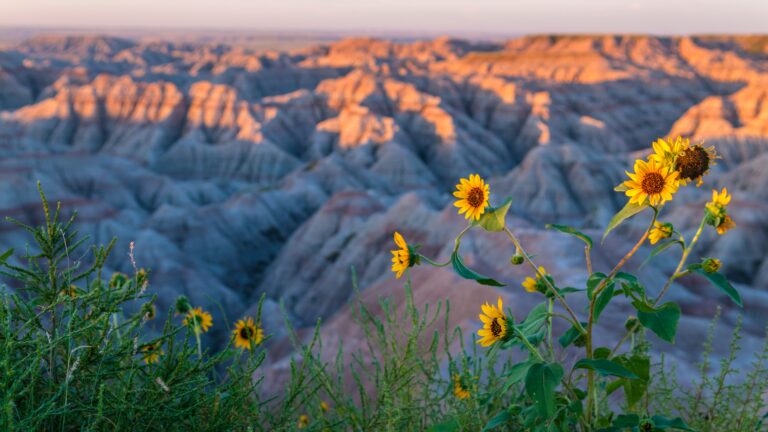
These striking landscapes, known for their colorful striped layers, deep gullies, and stark beauty, attract visitors worldwide. South Dakota’s Badlands are among the most renowned, with the Big Badlands Overlook offering breathtaking views ideal for capturing photos of Badlands National Park. These surreal terrains narrate a captivating geological history spanning millions of years, forming some of North America’s most distinctive and picturesque natural features.
Why Are They Called Badlands?
The name “badlands” has historical origins that reflect the challenging nature of these areas. Native Americans were the first to name these tough terrains, with the Lakota people calling them “mako sica,” meaning “land bad” or “eroded land.” This term described both the physical traits and the practical difficulties of the landscape.
When French fur traders and explorers arrived in the 18th and 19th centuries, they described these regions as “les mauvaises terres à traverser,” or “bad lands to travel across.” This phrase was eventually shortened to “badlands,” which remains the common name today.
Theodore Roosevelt, who spent considerable time in the North Dakota badlands during the 1880s, offered vivid descriptions of these landscapes. He depicted them as “a chaos of peaks, plateaus, and ridges,” highlighting their “fantastic and impressive” nature that seemed almost otherworldly.
The term “badlands” aptly captures the historical difficulties these regions posed to travelers. Before modern infrastructure, crossing these deeply eroded lands with steep slopes, loose soil, and scarce water was a formidable challenge. What early explorers saw as harsh obstacles are now appreciated as geological marvels, especially when viewed from vantage points like the Big Badlands Overlook.
How Are Badlands Formed?
The formation of badlands dates back to geological periods over 65 million years ago, during the late Cretaceous and early Tertiary. At that time, much of North America’s interior looked very different from today’s dry badlands.
The areas now known as badlands were once warm, swampy lowlands similar to the current Gulf Coast. Sediment from the rising Rocky Mountains was carried eastward, depositing layers of sand, silt, and clay in these basins. Visitors can observe these ancient layers at viewpoints like the Big Badlands Overlook, where the geological story unfolds in the rock strata.
Volcanic eruptions in the western United States also contributed ash layers, which appear as light-colored bands in many badlands formations today.
Over millions of years, these sediments hardened into rock layers such as siltstone, claystone, and sandstone, with some lignite coal layers formed from ancient swamp plants. The differing mineral content and erosion resistance of these rocks give badlands their distinctive colorful, striped appearance, especially visible from places like the Big Badlands Overlook.

The Colorful Geology of Badlands
Understanding the Layers
One of the most notable features of badlands is their vivid coloration. The bands of red, orange, yellow, white, gray, and purple create a natural palette that attracts photographers and artists aiming to capture Badlands National Park’s beauty.
These colors reveal the mineral makeup and depositional environment of each layer:
- Iron compounds produce reds and oranges through iron oxide, while different oxidation states create yellows and browns, indicating oxygen-rich sediment environments.
- Manganese minerals add purple hues, though less commonly than iron.
- Calcium carbonate, from ancient marine life or mineral deposits, forms white layers, marking times when seas or lakes covered the area.
- Organic materials, especially ancient plant matter, create dark layers, sometimes forming lignite coal.
- Scoria, a reddish-pink rock formed when underground coal fires baked clay, adds unique coloration in some areas.
- Bentonitic clay, from altered volcanic ash, forms blue-gray to black layers with a popcorn-like texture that expands and contracts with moisture.
Reading the Geological Timeline
The colorful strata in badlands represent a vast geological timeline. The oldest layers, at the bottom, date to the late Cretaceous period (70-65 million years ago) and often contain dinosaur fossils. Moving upward, the layers represent progressively more recent times.
Changes in color and composition reflect environmental shifts, such as transitions from swampy to drier conditions or periods when shallow seas covered the land.
Fossils found in these layers, especially in South Dakota’s Badlands, include mammals from the Oligocene epoch (30-23 million years ago), such as ancient horses, rhinos, camels, and more unusual species like oreodonts and nimravids.
By examining mineral content and fossils, geologists reconstruct ancient ecosystems, making badlands both scenic and scientifically valuable.
Famous Badlands Regions in North America
Badlands National Park, South Dakota
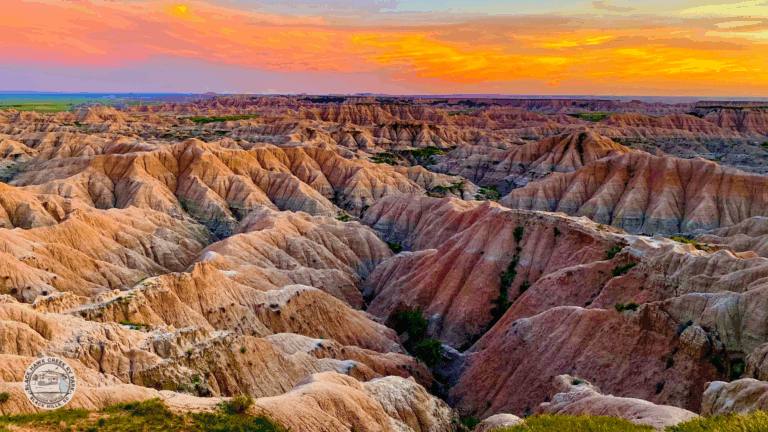
This park in southwestern South Dakota is one of North America’s most iconic badlands areas, covering about 244,000 acres. It features sharply eroded buttes, pinnacles, and spires set against the Great Plains.
The formations formed as the White River cut through sedimentary layers deposited between 75 and 28 million years ago. These layers contain rich fossil beds from the Oligocene epoch.
Visitors to the Big Badlands Overlook enjoy vast views of rugged terrain, with colors shifting throughout the day, perfect for photography.
Originally designated a national monument in 1939, it became a national park in 1978, recognising its geological, paleontological, and ecological importance.
Theodore Roosevelt National Park, North Dakota
Located in western North Dakota, this park protects over 70,000 acres of badlands along the Little Missouri River, divided into three units: North, South, and Elkhorn Ranch.
The park is historically significant due to Theodore Roosevelt’s time here, which influenced his conservation policies.
Geologically, these badlands differ from South Dakota’s, featuring more wooded areas along river bottoms and notable scoria formations.
The park offers colorful geology, diverse wildlife, and historical interest, providing a less crowded alternative for visitors.
Other Notable Badlands
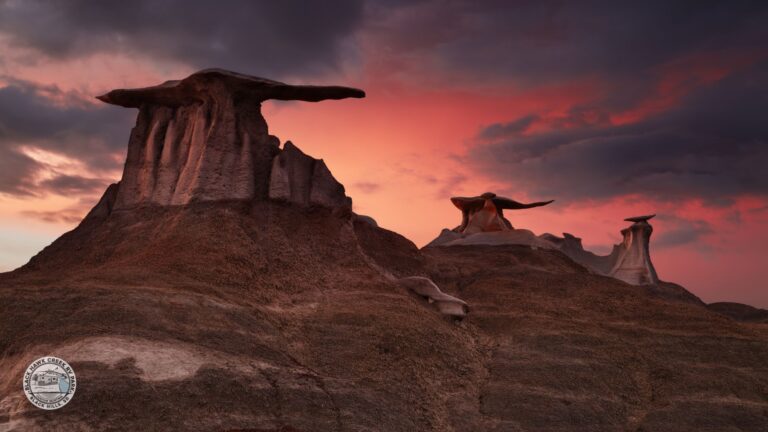
Besides the Dakotas, other important badlands include:
- Toadstool Geologic Park in Nebraska, known for mushroom-shaped formations and rich fossils.
- The Missouri Breaks in Montana, preserved within the Upper Missouri River Breaks National Monument, described by Lewis and Clark as “scenes of visionary enchantment.”
- Dinosaur Provincial Park in Alberta, Canada, famous for its rich dinosaur fossil discoveries and designated a UNESCO World Heritage Site.
Activities in Badlands National Park
Wildlife Viewing
Observe American bison roaming much of the North Unit, along with bighorn sheep, prairie dogs, black-footed ferrets, bobcats, and pronghorns—ideal subjects for photography. Maintain at least 100 feet distance from wildlife for safety.
Exploring Dinosaur Fossils
Near the Ben Reifel Visitor Center, the Fossil Discovery Trail offers exhibits on the park’s paleontology. Summer fossil talks are available; check the visitor center for schedules.
Cycling
Badlands National Park has paved, gravel, and dirt roads suitable for experienced cyclists. Along Badlands Loop Road, be prepared for narrow shoulders and increased traffic during peak seasons. Water is scarce, so bring sufficient supplies. More details are available at nps.gov.
Stargazing
The park’s night sky is exceptionally clear. From Memorial Day to Labor Day, ranger-led evening programs at the Cedar Park Campground amphitheater feature telescopes for viewing stars, planets, and constellations, weather permitting. Night programs start around 9:45 p.m. in early summer and 9:15 p.m. later in the season.
Hiking
Badlands National Park offers unique hiking opportunities, especially near the Ben Reifel Visitor Center in the North Unit. Unlike many parks, visitors can explore beyond marked trails, perfect for capturing memorable photos.
Cliff Shelf Trail, a half-mile boardwalk east of the visitor center, passes through juniper groves along the Badland Wall, with a 200-foot elevation gain and scenic views of the park’s southern areas.